

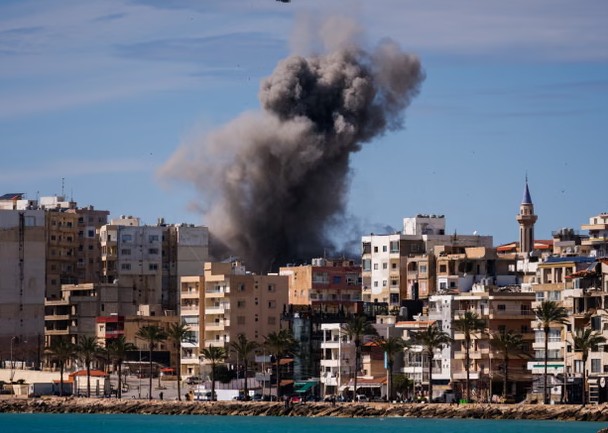


WASHINGTON, D.C. — The Israel-U.S.-Iran war appeared to pull in two directions over the last 12 hours: toward fresh escalation on the battlefield and toward uncertain diplomacy behind the scenes.
Iran fired new waves of missiles at Israel on Tuesday, with strikes hitting the Tel Aviv area and causing visible damage, even as President Donald Trump publicly suggested there had been “productive” contacts aimed at ending the fighting. Reuters reported that emergency crews were working at impact sites in central Israel, and that Iranian missiles again penetrated Israel’s air defenses in the latest round of attacks.
At the same time, the Pentagon was expected to send between 3,000 and 4,000 additional U.S. troops from the 82nd Airborne Division to the Middle East, according to Reuters, adding to an already large American military presence in the region. The deployment, if completed, would deepen a U.S. buildup that Reuters said had already reached about 50,000 troops in the region before the latest reinforcement plans.
That combination — incoming Iranian missiles and more U.S. forces — has undercut hopes that Trump’s latest talk of a possible deal meant the conflict was clearly moving toward de-escalation. Three senior Israeli officials told Reuters that Trump appeared determined to pursue an agreement, but they said they doubted Iran would accept the terms the United States is likely to demand, including curbs on Iran’s nuclear and ballistic missile programs. Iran, for its part, has denied Trump’s claim that talks already took place.
On the ground, Tuesday’s Israeli account was blunt: missiles from Iran again triggered sirens in densely populated areas, including Tel Aviv. Reuters reported that one strike carved a large crater in a road and damaged a multi-story apartment building, with no deaths immediately reported there. Israel also said it carried out a new wave of strikes in Tehran overnight, targeting command centers and missile-related sites.
Diplomatically, Pakistan’s prime minister publicly offered to host talks between Washington and Tehran if both sides agree, an indication that regional governments are trying to create an off-ramp. Reuters reported that a Pakistani government source described discussions over a possible meeting as being at an advanced stage, though still uncertain.
But the latest reporting from Reuters suggests Tehran’s negotiating position is hardening, not softening. Three senior sources in Tehran told Reuters that Iran now wants not only an end to the war, but also guarantees against future military action, compensation for wartime losses, and formal control of the Strait of Hormuz — demands likely to be nonstarters in Washington. Reuters also reported that the Revolutionary Guards have gained greater influence over decision-making inside Iran as the war has gone on.
The Strait of Hormuz remains one of the war’s most consequential pressure points. Reuters reported Tuesday evening that, according to a Financial Times account based on an Iranian letter to International Maritime Organization member states, Tehran said “non-hostile vessels” could transit the strait if they coordinate with Iranian authorities, while vessels linked to the United States, Israel or other participants in the war would not qualify. Reuters said it could not immediately verify that report. The same Reuters report said the war has all but halted shipments through a waterway that normally carries about a fifth of the world’s oil and liquefied natural gas.
That choke point has become central not just to the war effort, but to its global fallout. Reuters reported earlier Tuesday that Gulf pressure and fears of miscalculation helped persuade Trump to pause threatened U.S. strikes on Iranian power plants, as regional governments worried that a wider war could produce deeper attacks on energy infrastructure and shipping.
The U.S. military reinforcement now moving forward suggests Washington is still preparing for a broader range of contingencies, even if Trump is publicly emphasizing diplomacy. Reuters reported that no decision had been made to send U.S. ground troops into Iran itself, but the new deployment would expand American capacity for possible future operations. Reuters has separately reported that U.S. officials have discussed options tied to securing the Strait of Hormuz and even potential action around Iran’s Kharg Island oil hub.
Politically, the war is also becoming more costly for Trump at home. Reuters reported that a new Reuters/Ipsos poll found just 35% of Americans approve of the U.S. strikes on Iran, while 61% disapprove. Another Reuters report said Trump’s broader approval rating has fallen to 36%, pressured in part by rising fuel prices and public unease over the conflict.
So where does that leave the war tonight? The clearest answer is that the conflict remains unstable and highly fluid. Missiles are still flying. Israeli strikes are continuing. U.S. forces are still building up. And while multiple parties are talking about negotiations, the public positions of Washington, Jerusalem and Tehran still appear far apart.
For now, the latest 12-hour picture is this: more military pressure, more diplomatic signaling, and no verified breakthrough yet.