

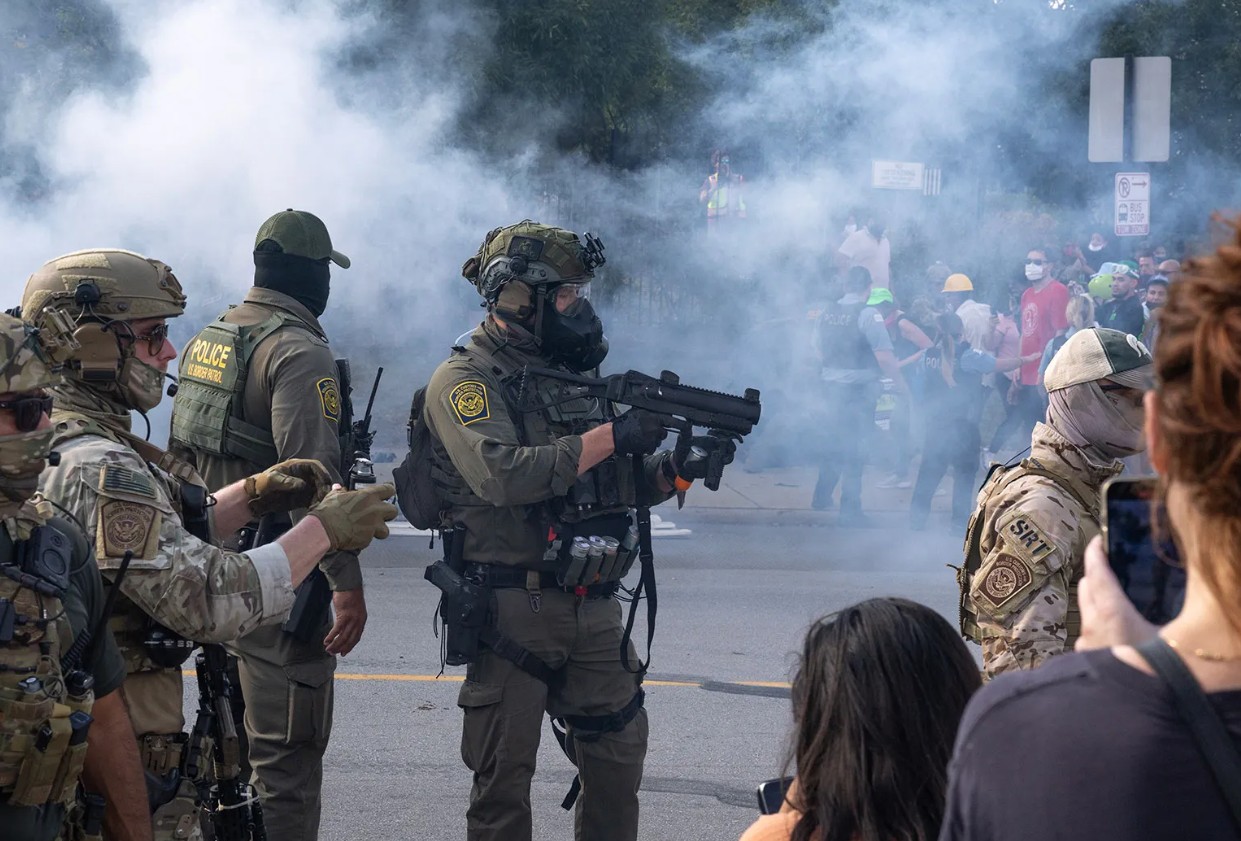


The Department of Homeland Security’s latest budget picture shows a department putting heavy weight behind enforcement capacity, training, and operational readiness, even as questions grow over how much it is spending on less-lethal weapons such as tear gas, pepper-ball systems, chemical munitions, and related crowd-control gear. The White House’s fiscal 2027 budget materials say DHS is set for a $118.4 billion request overall, while the broader federal budget says DHS would receive $63 billion in discretionary budget authority for 2027, a $2.2 billion drop from the 2026 continuing resolution level but with large added support coming through separate multiyear funding. The same administration budget materials also say the 2027 plan would maintain or increase investments in border security, immigration enforcement, and federal law enforcement hiring.
Within that larger picture, the agencies most relevant to less-lethal weapons spending are U.S. Customs and Border Protection, Immigration and Customs Enforcement, the Federal Protective Service, and the Federal Law Enforcement Training Centers. DHS budget documents indexed on the department’s own site show CBP at $23.0 billion in the FY 2026 budget, while a newly posted DHS component overview says ICE is at $10.5 billion in the FY 2027 budget. The FY 2027 Budget-in-Brief also says DHS is providing $418 million for FLETC, the department’s main law-enforcement training arm. Those numbers do not prove how much is being spent specifically on tear gas or kinetic impact munitions, but they show the scale of the agencies and training infrastructure through which those tools are typically bought, stored, trained on, and deployed.
One important limitation is that DHS’s public budget overviews do not appear to break out a neat departmentwide line item for “tear gas” or “less-lethal weapons.” That means anyone trying to understand current spending has to piece the story together from agency budget summaries, procurement notices, contract data, inspector general work, and watchdog inquiries. That is not unusual in federal law enforcement budgeting, where tactical equipment can be buried inside broader accounts for operations, training, readiness, uniforms and equipment, or mission support. But it does make public oversight harder, especially as the department’s operational footprint expands.
The strongest public evidence of recent less-lethal activity is coming from procurement channels. A new solicitation posted to SAM.gov just days ago describes a CBP requirement for “Less Lethal Specialty Munitions.” The listing says the procurement includes distraction devices and chemical munitions, a category that in law-enforcement practice can include tear-gas-type or pepper-based crowd-control tools. Another CBP solicitation on SAM describes a requirement for Less Lethal Pressurized Air Launcher Systems, which are commonly used to fire pepper-ball rounds or similar less-lethal projectiles. Those postings are not final spending totals, but they are clear evidence that CBP is actively buying or seeking to buy these systems now, not as a relic of past border crises or 2020-era civil unrest.
Public contract-tracking data points in the same direction. GovTribe, which tracks federal award records, reports that CBP made a $730,108.75 award to United Tactical Systems, doing business as PepperBall Technologies, for pressure launch systems and accessories, with performance running into 2025. GovTribe also reports a separate $692,695 CBP award to the same company for pressurized air launchers, and another CBP-related award structure involving less-than-lethal chemical munitions through Quantico Tactical, including one delivery order that GovTribe says was modified to $2.64 million in June 2025. Those figures should be read carefully because they come from a contract-tracking platform rather than a DHS narrative budget line, but taken together with current SAM solicitations, they strongly suggest continuing procurement of less-lethal gear at scale.
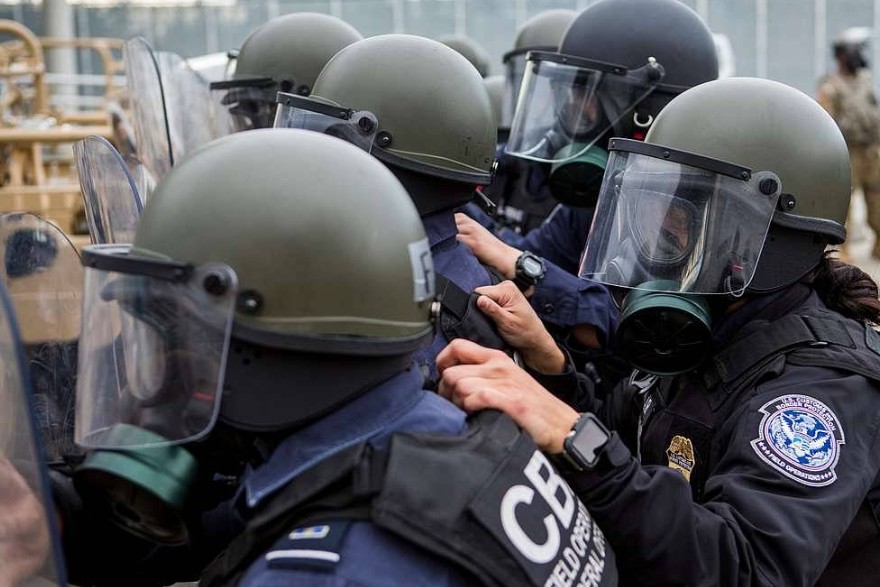
The public policy debate is not just about what DHS is buying. It is also about how these tools are used and tracked. A 2023 Government Accountability Office report found that DHS had updated its departmentwide use-of-force policy to align with Justice Department standards and said that CBP, ICE, FPS, and the Secret Service were required to update their own policies accordingly. But GAO also concluded DHS should strengthen its use-of-force data collection and analysis, a significant finding because less-lethal weapons are often treated as lower-profile incidents than shootings even though they can still cause serious injury. GAO’s report covered the department’s four largest law-enforcement components and highlighted the sheer size of that footprint: about 46,993 officers for CBP, 12,989 for ICE, 944 for FPS, and 5,210 for the Secret Service in the comparison tables it reviewed.
The same GAO report showed how differently DHS components report uses of force. CBP officers are generally required to orally report less-lethal force within an hour or as soon as feasible and file written reports within 72 hours. ICE officers are generally required to provide an oral report within an hour and a written supervisory report within 48 hours. Reporting timelines exist, but GAO’s central criticism was that DHS did not yet have strong enough departmentwide data collection and analysis to consistently understand patterns, risks, or policy compliance across components. In plain terms, the federal government may know it is buying and deploying these tools, but it does not necessarily make it easy for Congress or the public to see how often they are used, how they are reviewed, or where problem patterns emerge.
The inspector general’s office has also given the public at least one concrete benchmark on tear gas. In a 2020 report on the San Ysidro incidents in November 2018 and January 2019, DHS’s Office of Inspector General said CBP’s use of tear gas in response to physical threats appeared to fall within agency use-of-force policy. But the same review also raised concerns about CBP’s use of a long-range acoustic device in “alert tone” mode, warning that the practice may have increased the risk of hearing damage and left the government vulnerable to liability. That matters because it shows how less-lethal tools can be used inside policy and still raise serious oversight questions about safety, judgment, and accountability.
Recent political pressure has sharpened that oversight debate. In February, Democratic lawmakers on the House Homeland Security Committee demanded information from Secretary Kristi Noem about DHS’s use of “supposed less-lethal weapons,” including batons, pepper spray, tear gas, and rubber bullets. Their letter said such weapons can cause serious injuries and even death, and it asked for training materials, incident data, and details on how DHS officers have used those tools in American communities. That letter is not proof of wrongdoing by itself, but it shows Congress is now treating less-lethal force as a live oversight issue, not a settled matter from older border confrontations or protest crackdowns.
There is also a legislative push to go beyond internal policy. House Democrats in January announced the DHS Use of Force Oversight Act, which would codify a departmentwide policy on use of force and de-escalation and create new reporting and oversight mechanisms. The measure’s backers argue that DHS should not simply rely on internal guidance that can be loosened, ignored, or unevenly implemented. Again, the existence of the bill does not establish current misconduct across the board, but it does show a belief among some lawmakers that existing oversight of DHS force, including less-lethal force, is not strong enough.
What emerges from all of this is a picture of a department that is plainly sustaining enforcement-heavy operations, maintaining a large law-enforcement workforce, and continuing to procure less-lethal systems and munitions, while still offering only partial public visibility into how much is being spent on those tools as a category. The public budget record is strongest on the size of DHS and its components, clear on support for training and enforcement, and specific enough to show active CBP procurement of less-lethal launchers and specialty munitions. Where it remains weaker is in giving the public a simple answer to a basic question: how much, in total, is DHS now spending on tear gas, pepper-ball systems, chemical irritants, and related less-lethal weapons?
That gap matters more now because the spending is no longer hypothetical. It sits at the intersection of a bigger DHS budget, a stronger law-enforcement posture, fresh procurement activity, and unresolved oversight concerns from GAO, the inspector general, and lawmakers. For readers trying to understand where federal homeland security money is going, the short answer is that DHS appears to be investing steadily in the tools, training, and agencies that support less-lethal force. The longer answer is that the government still does not make it easy to follow the money all the way from top-line homeland security budgets to the canisters, launchers, rounds, and chemical agents that officers may eventually carry into the field.