

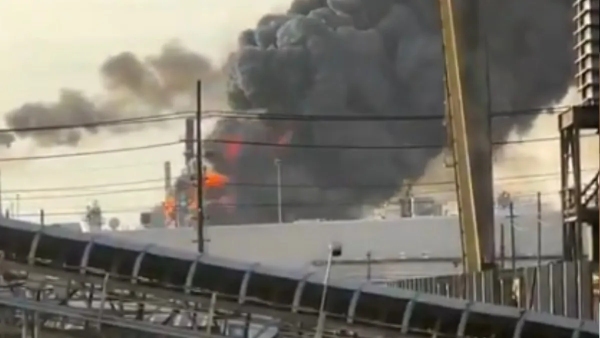


PORT ARTHUR, Texas — A large explosion and fire at Valero’s refinery in Port Arthur sent thick black smoke over the city and triggered a shelter-in-place order for nearby neighborhoods, though officials said Tuesday that the fire had been extinguished and no injuries were reported.
The incident occurred Monday at the Valero Port Arthur refinery, one of the largest fuel-making facilities on the Gulf Coast. By Tuesday, local officials and the company said all refinery personnel had been accounted for, the fire was under control, and precautionary shelter orders had been lifted after air monitoring found no ongoing public threat.
Initial public reports described a loud blast followed by flames and a towering smoke plume visible from surrounding areas. Local residents reported hearing the boom and feeling homes shake, underscoring the scale of the event even as authorities urged caution about unverified details in the immediate aftermath.
Authorities issued a shelter-in-place order for parts of Port Arthur on Monday as emergency crews responded and air-quality concerns mounted. Coverage from regional outlets indicated the order affected sections of the city west of Stillwell Boulevard and south of State Highway 73, including areas such as Pleasure Island and Sabine Pass, before being lifted Tuesday morning.
Valero said all workers were safe and that there were no “recordable injuries” tied to the incident, according to local reporting Tuesday. The cause of the explosion and subsequent fire remains under investigation. Officials have not publicly released a final determination on what equipment failed or what triggered the blast.
The refinery is a major industrial site in Southeast Texas. Valero’s Port Arthur complex employs roughly 770 people and processes about 435,000 barrels of crude oil per day into products including gasoline, diesel and jet fuel, according to company information cited by multiple news outlets. Its size and location near the Texas coast meant the fire drew immediate concern not only for nearby residents but also for regional fuel markets.
Emergency response agencies, including the Port Arthur Fire Department and the Texas Commission on Environmental Quality, were involved in monitoring conditions around the refinery. According to the Associated Press and regional reports, air-quality testing conducted after the fire found no continuing environmental hazard by the time the shelter-in-place order was lifted.
Even so, as with any refinery fire, authorities moved carefully. Large industrial fires can release combustion byproducts and raise concerns about short-term exposure, particularly for residents living closest to the site. In this case, officials said the available monitoring did not show a threat requiring the shelter order to remain in place, but investigators were still working to determine exactly what happened inside the facility.
Reuters reported that the fire struck one of Valero’s Port Arthur refining units late Monday and that the company shut the refinery after the explosion, citing sources familiar with the matter. That reporting points to possible operational disruptions beyond the immediate fire response, although the full extent and expected duration of any shutdown had not been fully outlined in public statements early Tuesday.
That matters because Port Arthur is one of the most strategically significant refining hubs in the country. A disruption at a facility of this scale can affect fuel supply chains, especially on the Gulf Coast, though the market impact of any single outage depends on how much equipment is damaged and how quickly operations can resume. Reuters and other outlets reported that traders and analysts were quickly watching the incident for signs of broader supply effects.
Still, in the first hours after the explosion, public safety was the overriding concern. Mayor Charlotte M. Moses said Tuesday that the city was fortunate the incident did not turn into a mass-casualty event, according to the AP. Her remarks reflected the seriousness of a refinery blast in a community long accustomed to living alongside heavy industry but still vulnerable when an emergency unfolds at this scale.
Port Arthur, near the Texas-Louisiana border, has a long history as an energy and petrochemical center. That industrial identity brings jobs and economic activity, but it also means residents are familiar with emergency alerts, air-monitoring concerns and the uncertainty that follows any major plant incident. Monday’s explosion again placed that tension in sharp relief as residents were told to stay indoors while responders worked the scene.
As of Tuesday afternoon, the clearest confirmed facts were these: an explosion and major fire occurred at the Valero refinery in Port Arthur on Monday; a shelter-in-place order was issued and later lifted; no injuries were reported; and the cause remained under investigation. Officials had not, at the time of reporting, announced any fatalities, evacuation expansion, or confirmed off-site contamination tied to the incident.
Because this is an active, developing story, some early accounts differ on specifics such as the exact unit involved or the precise time of the blast. That is common in fast-moving industrial emergencies, and responsible reporting depends on separating confirmed official statements from eyewitness observations and preliminary reports. At this stage, the broad outline of the event is clear, while the technical cause and longer-term operational impact remain unresolved.
Further updates are expected from Valero, local officials and state environmental authorities as the investigation continues.