

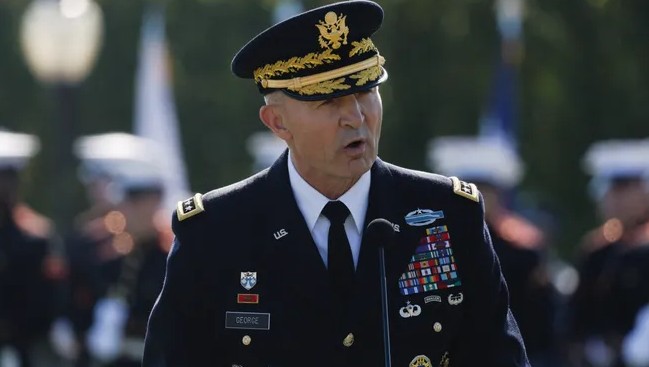


WASHINGTON D.C. – Gen. Randy A. George’s forced early retirement as Army chief of staff is one of the most consequential Pentagon personnel moves of the year, not simply because he was the service’s top uniformed officer, but because it happened in the middle of active U.S. combat operations tied to Iran. Reuters and The Associated Press reported on April 2 that Defense Secretary Pete Hegseth asked George to step down and retire immediately, ending his tenure more than a year before it would normally have concluded. The Pentagon did not publicly provide a reason for the move, and the timing immediately raised questions about continuity, military judgment, and the message it sends to commanders and troops during wartime.
George was not a short-timer at the end of a long natural transition. The Army’s official leadership page says he became the 41st chief of staff of the Army on Sept. 21, 2023, after serving as vice chief of staff, and Reuters reported he still had more than a year left in what is typically a four-year term. A West Point graduate commissioned in 1988, George served in Desert Shield, Desert Storm, Iraq, and Afghanistan, and commanded at multiple levels across his career. That matters because his removal was not the routine passing of the baton to a known successor at a calm moment. It was the abrupt sidelining of a sitting Army chief with combat experience and institutional credibility while U.S. forces were already engaged in a dangerous and expanding war.
The official language used by the Pentagon softened the reality, describing George’s retirement as “effective immediately.” But Reuters, AP, CBS News, and The Washington Post all reported that the retirement was not voluntary in the ordinary sense. Their reporting described George as having been asked to step down by Hegseth, with CBS adding that one source said Hegseth wanted someone who would carry out “President Trump and Hegseth’s vision for the Army.” That distinction is central to understanding why the story matters. This was not simply an aging general deciding the time had come. It was a politically directed removal of the Army’s top uniformed officer at a moment when the Army is supporting combat operations, force flow, logistics, and deterrence across a major regional war.
The wartime context is what makes George’s exit especially extraordinary. AP reported the move came while the United States was involved in military operations against Iran and while thousands of U.S. troops, including Army paratroopers and Marines, were deployed to the Middle East with no publicly announced end point. Reuters likewise framed the firing as a rare wartime dismissal. In Washington, senior military leadership changes always carry operational implications, but they are particularly destabilizing when the Army is helping manage force posture, sustainment, contingency planning, and possible escalation. A service chief is not a battlefield theater commander, but the chief of staff is central to readiness, force generation, equipment priorities, manpower, and the Army’s internal ability to translate political direction into military execution.
That is why George’s removal has been read as more than a personnel dispute. The Washington Post reported that the ouster is part of a broader reshaping of senior military leadership under Hegseth, who has often removed top officers without public explanation. AP similarly noted that George’s departure fits into a wider pattern of firings that has included more than a dozen senior military leaders in the past year. During peacetime, that kind of ideological or managerial overhaul would already generate concerns about politicization. During war, it also raises operational questions: Are commanders being judged primarily on battlefield performance, or on alignment with a political vision? And if the answer appears to be the latter, what does that do to candor inside the chain of command?
The Pentagon did not publicly accuse George of misconduct, strategic failure, or insubordination. Reuters said no reason was provided. AP said the same. That vacuum is important because when there is no public case against a senior wartime officer, observers naturally look for political explanations. The reporting from CBS News pointed in that direction, saying Hegseth wanted a leader more closely aligned with his and Trump’s vision. The Washington Post reported that many of the officers removed under Hegseth had connections to prior administrations or had held positions the defense secretary has targeted for reform. None of that proves a single motive in George’s case, but it does show why the retirement is being viewed as a political purge rather than a standard wartime correction.
The abruptness of the move magnified the shock. AP reported that Gen. Christopher LaNeve would take over in an acting capacity. Reuters also said George was replaced by LaNeve. Acting replacements can keep an institution moving, but they are still stopgaps unless and until the White House nominates a permanent successor and the Senate confirms one. In war, acting status matters. It can constrain long-range planning, complicate internal authority, and create uncertainty about whether commanders are making decisions for the long haul or merely keeping the seat warm for someone else. That kind of uncertainty is not abstract. It touches procurement, force structure debates, training priorities, and the Army’s ability to present a stable face to soldiers who are already watching a war widen.
George’s own résumé underscores why his departure resonated so sharply inside military circles. The Army’s official biography notes that he commanded at the company, battalion, brigade, division, and corps levels and served as senior military assistant to the secretary of defense before becoming vice chief and then chief of staff. In practical terms, that made him an officer steeped not only in tactical and operational command, but in the Pentagon’s highest-level decision-making machinery. George also came into the chief’s role during a period when the Army was grappling with recruiting challenges, modernization priorities, drone threats, long-range fires, and the demand signal created by conflicts in Europe and the Middle East. Removing a chief with that background in the middle of an active war is not just symbolic; it removes a senior manager of institutional memory at a moment when institutional memory has immediate value.
CBS News added another piece that helps explain why the story is reverberating: George’s outgoing message. CBS reported on April 4 that George told Pentagon officials in a farewell email that U.S. soldiers deserve “courageous leaders of character.” Even without an explicit denunciation, that line landed as more than boilerplate. It suggested George understood his removal as part of a larger question about leadership standards, moral courage, and the quality of command climate being established at the top. In ordinary circumstances, such a phrase might pass as generic. In the wake of a forced retirement during war, it reads as an argument about what the Army most needs at exactly the moment it lost its chief.
The Army itself is structured to absorb leadership turnover, and it would be wrong to suggest that one firing automatically produces battlefield failure. The institution is large, layered, and professional. Combatant commanders, theater staffs, corps headquarters, and Army component commands do not stop functioning because the chief of staff changes. But that is not the same as saying the loss is insignificant. Service chiefs set priorities, defend budgets, shape promotions, influence doctrine, and provide the civilian leadership with their best military advice. The deeper concern is less about whether the Army can function tomorrow morning and more about whether senior officers will feel free to offer unwelcome advice tomorrow afternoon. When wartime dismissals occur without a public performance rationale, the signal can travel fast through the ranks: alignment matters.
There is also the broader civil-military issue. Presidents and defense secretaries unquestionably have the authority to select leaders they trust. Civilian control is not optional; it is foundational. But stable civilian control is not the same as constant ideological turnover, particularly in wartime. The Post and AP both placed George’s retirement inside a pattern of senior-level removals. That pattern matters because the military’s effectiveness depends partly on subordinates believing that promotions and dismissals are tied to competence, integrity, and mission performance. Once the perception spreads that political compatibility is the real currency, a wartime military can become more cautious upward, less candid in internal debate, and more brittle under pressure.
George’s early departure also landed at a moment when the war itself is already increasing risk for the Army. Reuters and AP both described an environment of active U.S. operations, troop deployments, and uncertainty over how long the conflict might last. Wartime Army demands are not limited to infantry formations or front-line units. The service is central to missile defense support, logistics networks, ammunition flows, force protection, sustainment, medical planning, transportation, and reinforcement options if the conflict broadens. Leadership stability at the top of that system is not a luxury. It is part of the war effort. Removing the chief without a public operational justification inevitably invites the question of whether political priorities are being placed ahead of wartime continuity.
The question now is not only why George was pushed out, but what standard his successor will be expected to meet. If the principal test is strategic effectiveness, Congress and the public will want to see clear evidence that the Army becomes stronger, more coherent, and better prepared under new leadership. If the principal test is political alignment, the cost may not show up immediately in headlines, but over time it can erode trust, distort advice, and narrow the space for honest dissent inside the building. George’s retirement is therefore bigger than one general’s career arc. It is a live test of how the Trump-Hegseth Pentagon intends to run the Army during war: as a professional institution built to absorb pressure and speak candidly upward, or as an organization whose top ranks can be rapidly reordered whenever political patience runs thin.
In the short term, the Army will keep moving. It always does. But George’s premature retirement leaves behind a harder question that will not be answered by a seamless ceremony or an acting replacement. At a time of war, the removal of the Army chief without a public, performance-based explanation is not just another personnel headline. It is a stress test for military professionalism, civilian oversight, and the credibility of the administration’s claim that it is making decisions based on what the war requires rather than what politics demands. George entered the job in September 2023 as the Army’s 41st chief of staff. He exits it in April 2026 under circumstances that will likely be debated long after the immediate personnel paperwork is complete.