

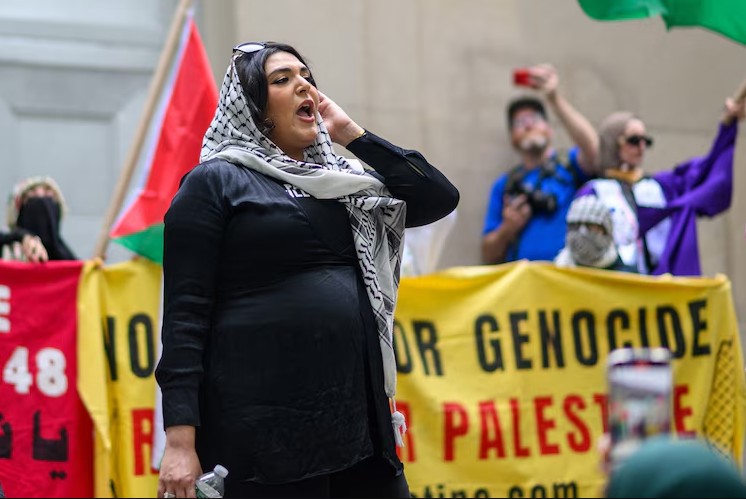


NEW YORK — Law enforcement officials have disrupted what authorities describe as a planned firebombing targeting the New York City home of Palestinian activist Nerdeen Kiswani, according to reporting by the Associated Press, in a case that investigators say underscores rising concerns about politically motivated violence amid heightened tensions surrounding the Israel-Palestinian conflict.
Authorities say the plot was uncovered during an active investigation into threats directed at Kiswani, a prominent New York-based organizer and chair of the pro-Palestinian advocacy group Within Our Lifetime. While specific details about suspects and the timeline of the alleged plan remain limited, officials indicated that the threat involved preparations consistent with an attempted arson attack targeting her residence.
The disruption of the alleged plot, officials said, likely prevented a potentially serious act of violence in one of the nation’s largest cities, where law enforcement agencies have been on heightened alert for threats linked to geopolitical tensions and domestic extremism.
Kiswani, who has been a visible figure in organizing protests and demonstrations related to Palestinian rights, has frequently drawn both support and criticism for her activism. In recent months, her public profile has grown as demonstrations across New York City and other major urban centers have intensified, often drawing large crowds and, at times, counter-protests.
Authorities have not publicly detailed how the alleged plot was discovered, but officials familiar with similar investigations say such threats are often identified through a combination of intelligence monitoring, tips from the public, and digital surveillance of online communications. Law enforcement sources indicated that once credible information emerged, agencies moved quickly to assess the risk and intervene.
The incident comes amid a broader national climate in which threats against activists, religious communities, and political figures have increased, prompting law enforcement agencies to devote additional resources to monitoring potential acts of violence. In New York City, officials have repeatedly warned of the risk of retaliatory or ideologically driven attacks connected to international conflicts, particularly those that resonate strongly within local communities.
While authorities have not confirmed whether the alleged plot was directly tied to any organized group, investigators are examining possible motivations, including whether the threat was driven by political ideology, personal grievance, or a combination of factors. Cases involving targeted violence against activists often fall into complex legal and investigative categories, where determining intent is a critical component of potential prosecution.
In a brief statement following the report, Kiswani acknowledged the situation and expressed concern about the broader climate surrounding political activism. She described the alleged plot as part of a pattern of intimidation faced by organizers and emphasized the importance of protecting the right to engage in peaceful advocacy.
“I will not be intimidated,” she said, according to individuals familiar with her response, adding that threats against activists reflect a growing effort to silence dissenting voices.
Law enforcement officials have not yet announced any arrests in connection with the alleged plot, and it remains unclear whether charges are pending. Investigators are continuing to review evidence, including digital communications and any materials recovered during the course of the investigation.
Legal experts note that cases involving planned acts of arson or firebombing are typically prosecuted under both state and federal statutes, depending on the circumstances. If the plot is determined to have been motivated by political or ideological factors, it could also raise the possibility of hate crime or domestic terrorism-related charges.
The disruption of the alleged attack highlights the challenges facing law enforcement as they navigate a landscape where threats can emerge rapidly and spread across both physical and digital spaces. Officials have emphasized the importance of vigilance and cooperation between agencies, as well as the role of community awareness in identifying potential risks.
At the same time, civil liberties advocates have cautioned that increased surveillance and enforcement efforts must be balanced with protections for constitutional rights, particularly in cases involving political expression. The tension between security and civil liberties remains a central issue in how authorities respond to emerging threats.
New York City officials have not issued a broader public alert related to the incident, but the case is likely to add to ongoing discussions about public safety and the protection of individuals engaged in high-profile advocacy work. The city, which has long been a focal point for political demonstrations, has seen a range of protests in recent years, many tied to international events with local resonance.
For Kiswani and others involved in similar movements, the alleged plot serves as a stark reminder of the risks associated with public activism. Advocates say that while threats are not new, the intensity and frequency of such incidents appear to be increasing, reflecting a more polarized and volatile environment.
As the investigation continues, authorities are expected to provide additional details about the nature of the threat, the individuals involved, and the steps taken to prevent the attack. For now, officials say the priority remains ensuring the safety of those targeted and maintaining public confidence in the ability of law enforcement to respond to emerging threats.
The case, while still developing, underscores a broader reality facing cities across the country: the intersection of global conflict, domestic politics, and individual activism can create conditions where tensions escalate beyond rhetoric, requiring swift and coordinated action to prevent violence.
For residents of New York City, the thwarted plot is both a reassurance and a warning—evidence that threats can be stopped, but also a reminder of the underlying forces that continue to drive them.