

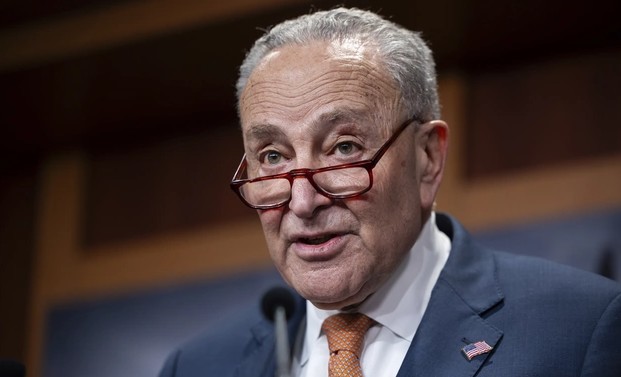


WASHINGTON — Senate Minority Leader Chuck Schumer escalated his confrontation with Donald Trump in the past 12 hours, accusing the president of attempting to leverage federal funding negotiations to influence the outcome of the 2026 midterm elections.
At the center of the dispute is Trump’s insistence that Congress pass the SAVE America Act, a controversial voting measure that would impose stricter voter identification and proof-of-citizenship requirements, as a condition for resolving the ongoing Department of Homeland Security (DHS) funding standoff.
Schumer sharply rejected that demand, calling it an inappropriate attempt to tie election policy to essential government funding.
“Donald Trump is now saying we’ll pay TSA only after Congress passes voter suppression,” Schumer said in remarks on the Senate floor, adding that the proposal is unlikely to pass and should not be linked to DHS operations.
High-Stakes Negotiations Collide With Election-Year Politics
Despite the heated rhetoric, Schumer described ongoing negotiations over DHS funding as “constructive,” signaling that talks between Democrats, Republicans, and the White House had continued through the weekend.
However, he also accused Trump of actively undermining those discussions, saying the president had instructed Republicans not to reach any agreement unless the voting legislation is included.
That demand has complicated efforts to resolve the partial DHS shutdown, which has already disrupted airport operations nationwide due to unpaid Transportation Security Administration (TSA) workers and staffing shortages.
A potential compromise being discussed in the Senate would fund most of DHS operations—particularly TSA—while excluding key components of Trump’s immigration enforcement agenda.
Midterm Elections at the Center of the Fight
The standoff is increasingly being viewed through the lens of the 2026 midterm elections, where control of Congress is at stake.
All 435 seats in the U.S. House of Representatives and a portion of the Senate will be contested in November 2026, making voting laws and election procedures a central political issue.
Schumer and other Democrats argue that the SAVE America Act is designed to reshape voting access ahead of those elections, while Republicans have framed the legislation as necessary to ensure election integrity.
In his remarks, Schumer suggested Trump’s strategy is politically motivated, accusing the president of prioritizing electoral advantage over governance.
“He cares about his own election,” Schumer said, referring to Trump’s push for the legislation.
Republican Pressure and Strategic Divide
The situation has also exposed divisions within the Republican Party, with some senators reportedly seeking a path to fund DHS without tying it directly to the voting legislation.
According to recent reporting, lawmakers from both parties have expressed urgency in reaching a deal as disruptions at airports worsen and pressure builds from federal workers and the traveling public.
At the same time, Trump has urged Republicans to hold firm, even suggesting they avoid compromise altogether unless their broader legislative priorities are met.
What Happens Next
With negotiations ongoing, the next 24 to 48 hours are expected to be critical.
Lawmakers are weighing whether a partial funding agreement can move forward without resolving the voting law dispute—a decision that could determine both the immediate future of DHS operations and the broader political dynamics heading into the midterms.
For now, the situation remains fluid:
- DHS funding talks continue
- Voting legislation remains stalled
- Political pressure is intensifying on both sides
- The Bigger Picture
The clash between Schumer and Trump highlights a broader trend as the 2026 midterm elections approach: policy debates are increasingly intertwined with electoral strategy.
Issues like immigration, voting access, and federal funding are no longer just legislative questions—they are becoming defining battlegrounds for control of Congress.
And as this latest standoff shows, those battles are already underway. This is a developing story. Updates will be provided as more information becomes available.