

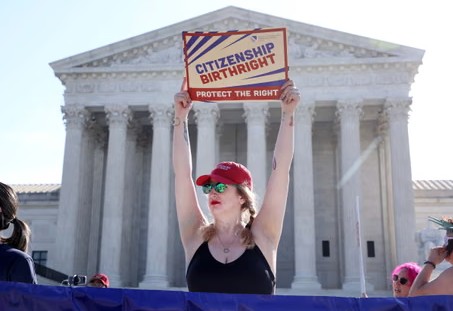


Courts Hold Fast Against Attack On 14th Amendment
WASHINGTON D.C. – The U.S. Supreme Court appeared strongly skeptical during April 1 arguments over President Donald Trump’s order seeking to restrict birthright citizenship, with justices across the ideological spectrum pressing the administration on the Constitution’s text, the practical mechanics of enforcing the policy, and whether it conflicts with long-settled precedent. Reuters reported that both conservative and liberal justices raised doubts about the order, while the Associated Press said the court seemed poised to reject the restriction outright.
Justices Focused on the 14th Amendment’s Text
A central problem for the administration was the text of the Citizenship Clause itself. The 14th Amendment says that all persons born or naturalized in the United States, and “subject to the jurisdiction thereof,” are citizens. During arguments, Justice Elena Kagan told Solicitor General D. John Sauer that the administration was relying on “pretty obscure sources” to reach its interpretation, signaling concern that the order was trying to narrow constitutional language that has long been read broadly. Reuters reported that Kagan’s questioning reflected wider concern on the bench that the administration’s legal theory was not supported by the amendment’s actual wording.
Conservative Justices Also Pressed the Government
The court’s skepticism was not limited to its liberal members. Reuters reported that Justice Neil Gorsuch sharply questioned how the administration’s proposed “lawful domicile” test would work in real life, asking whose domicile would count, how it would be determined, and whether that inquiry would have to be made for every birth. Justice Amy Coney Barrett also pressed the government on implementation, pointing to cases in which a child’s parents may be unknown or where intent to remain in the United States would be impossible to determine at birth. Those questions suggested concern not only with constitutional theory, but with whether the order could be administered fairly or coherently.
Wong Kim Ark Loomed Over the Argument
Another major obstacle for the administration was the 1898 Supreme Court decision in United States v. Wong Kim Ark, which has long been understood as the bedrock case for birthright citizenship. Reuters reported that Gorsuch signaled discomfort with the administration’s effort to rely on that case, noting that even Justice John Marshall Harlan’s dissent in Wong Kim Ark later recognized that the ruling covered children of temporary visitors. That line of questioning was significant because it showed skepticism from a conservative justice toward the administration’s attempt to reinterpret one of the most important citizenship precedents in American law.
AP Described a Court That Seemed Ready to Reject the Policy
The Associated Press went further than simply describing a tough hearing, reporting that the Supreme Court “seemed poised” to reject Trump’s restrictions. AP said conservative and liberal justices alike questioned whether the order complied with either the Constitution or federal law. That is a notable signal in a case involving one of the administration’s most ambitious immigration actions, especially because the current court has often backed Trump on other immigration-related disputes.
Lower Courts Have Already Uniformly Blocked the Order
The skepticism at the Supreme Court follows a near-uniform rejection of the order in lower courts. AP reported that federal courts have consistently blocked the directive and that the New Hampshire judge whose ruling is now under review concluded the executive order likely violates both the Fourteenth Amendment and federal law. AP also noted that judges reviewing the policy have described it as contrary to long-established understandings of citizenship and inconsistent with the original meaning and structure of the amendment.
What Is at Stake
The stakes extend beyond constitutional doctrine. Reuters reported that an eventual ruling upholding the administration’s theory could affect as many as 250,000 babies born each year and could require families of millions more to prove the citizenship status of newborn children. Lower court rulings summarized by AP warned that denying citizenship in such cases could leave some children undocumented or even stateless. Those consequences appeared to hover over the courtroom as the justices tested whether the government’s theory was workable, lawful, or consistent with more than a century of American practice.
The clearest takeaway from the argument was not simply that the justices had questions, but that several appeared deeply unconvinced by the administration’s core theory. With a decision expected by the end of June, the case now stands as one of the most consequential legal tests yet of executive power, immigration policy, and the constitutional meaning of citizenship in Trump’s second term.