

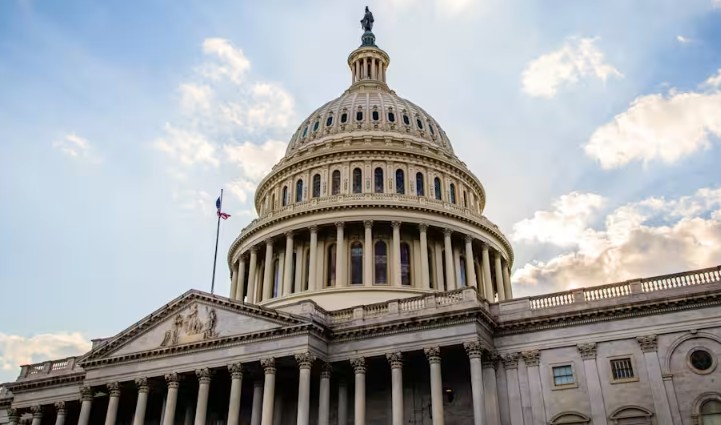


WASHINGTON — In a dramatic turn after weeks of gridlock, the U.S. Senate has approved a critical budget measure aimed at reopening much of the Department of Homeland Security, capping a high-stakes standoff that exposed deep partisan divisions over immigration policy, federal spending priorities, and the limits of executive power.
The vote, which came early Friday following intense negotiations and repeated failed attempts, marks a significant—though incomplete—breakthrough in a budget battle that has stretched for more than six weeks and disrupted core government operations across the country. While lawmakers ultimately reached consensus on funding key agencies, the agreement leaves unresolved the central issue that fueled the impasse: how to fund and regulate federal immigration enforcement, particularly operations tied to U.S. Immigration and Customs Enforcement.
The Senate’s action follows a series of failed procedural votes that repeatedly fell short of the 60-vote threshold needed to advance legislation. At one point, the chamber had rejected similar measures as many as seven times, underscoring the entrenched nature of the dispute and the difficulty of bridging ideological divides within a narrowly split Senate.
The breakthrough came when lawmakers shifted strategy, advancing a narrower funding package that focuses on keeping much of the Department of Homeland Security operational while sidestepping the most contentious immigration provisions. The measure funds agencies such as the Transportation Security Administration, the Federal Emergency Management Agency, and the Coast Guard, all of which had been operating under severe strain during the shutdown.
However, notably absent from the agreement is funding for certain immigration enforcement operations, a compromise that reflects both the urgency of reopening essential services and the continued inability of lawmakers to reconcile opposing visions for federal immigration policy.
The prolonged shutdown had already begun to produce tangible consequences across the country. Airport security lines stretched for hours as Transportation Security Administration staffing levels dropped amid missed paychecks and rising attrition. Reports indicated that hundreds of TSA agents had left their positions, while others struggled to remain on the job without pay.
The mounting pressure from these disruptions—particularly as spring travel demand increased—became a decisive factor in forcing lawmakers back to the negotiating table.
Senate Majority Leader John Thune, a Republican, acknowledged the imperfect nature of the agreement but framed it as a necessary step to restore basic government functions. In remarks during negotiations, Thune criticized Democratic demands tied to immigration enforcement, saying they were “not even close to being real,” reflecting Republican frustration with proposals they viewed as politically driven and impractical.
At the same time, Thune signaled the urgency of reaching a resolution, noting the broader consequences of continued inaction and emphasizing the need to reopen agencies critical to national security and disaster response.
Democratic leaders, however, characterized the outcome differently, arguing that while the final bill did not include their proposed reforms, it represented a partial victory by preventing additional funding increases for immigration enforcement agencies. Senate Minority Leader Chuck Schumer defended his party’s position throughout the negotiations, describing Democratic proposals as “a reasonable, good-faith proposal” aimed at introducing what he called “commonsense guardrails” on ICE operations.
Schumer and other Democrats had pushed for provisions requiring greater transparency and accountability from federal immigration agents, including limits on the use of face coverings and stricter requirements for judicial warrants. Those provisions ultimately did not make it into the final bill, but the debate surrounding them shaped the contours of the negotiations and highlighted the broader policy conflict at play.
The divide between the parties was further illustrated by public comments from rank-and-file senators, many of whom expressed frustration not only with the opposing side but with the overall legislative process. Senator Katie Britt, a Republican involved in negotiations, underscored the urgency of the situation, telling reporters, “We have to” reach a deal by the end of the week, a reflection of the mounting pressure lawmakers faced as the shutdown dragged on.
Meanwhile, Democratic lawmakers emphasized the human toll of the impasse. During floor debates and media appearances, several senators pointed to the financial hardship experienced by federal workers, including TSA agents who had gone weeks without pay. One lawmaker described the situation in stark terms, noting that some workers were “sleeping in their cars” and taking on additional jobs to make ends meet while continuing to perform critical national security functions.
The political backdrop to the Senate vote added another layer of complexity. President Donald Trump, who has remained deeply involved in the negotiations, took the extraordinary step of announcing that he would use executive authority to ensure TSA workers were paid, even as Congress remained deadlocked. The move, which drew both praise and criticism, underscored the severity of the crisis and raised questions about the balance of power between the legislative and executive branches.
Trump’s intervention also intensified the political rhetoric surrounding the budget fight. The president accused Democrats of prolonging the shutdown for political gain, while Democratic leaders countered that Republicans had refused to engage seriously on immigration reforms tied to funding negotiations.
Despite the Senate’s passage of the funding measure, significant uncertainty remains. The bill must still be considered by the House of Representatives, where divisions within the Republican caucus and pressure from conservative factions could complicate its path forward. Some House lawmakers have already expressed skepticism about the approach taken by the Senate, particularly the decision to separate immigration enforcement funding from broader DHS appropriations.
Even if the bill ultimately becomes law, the underlying policy dispute is far from resolved. Republicans have indicated they will pursue additional funding for immigration enforcement through future legislation, potentially using the budget reconciliation process to bypass the Senate’s filibuster rules. Democrats, meanwhile, have vowed to continue pushing for reforms aimed at increasing oversight and accountability within federal immigration agencies.
The broader implications of the Senate vote extend beyond the immediate budget crisis. The episode has exposed the fragility of bipartisan cooperation in an era of heightened political polarization, particularly on issues related to immigration and national security. It has also highlighted the challenges of governing in a closely divided Congress, where even routine funding measures can become vehicles for larger ideological battles.
For federal workers and the agencies affected by the shutdown, the Senate’s action offers a measure of relief, though it comes after weeks of uncertainty and disruption. For travelers, the expected restoration of TSA operations may ease some of the delays and frustrations that have plagued airports in recent weeks.
But for lawmakers, the vote is less an endpoint than a temporary pause in an ongoing conflict. As negotiations continue and new legislative efforts take shape, the same fundamental questions that drove the shutdown—about the role of immigration enforcement, the scope of federal authority, and the priorities of the federal budget—are likely to resurface.
In that sense, the Senate’s vote represents both a resolution and a warning: a reminder that even when agreement is reached, the deeper divisions within the political system remain unresolved, shaping the course of policy debates in Washington and beyond.